
 Multiple Faces Detected


 March 17th, 2026
Everyone assumes they’re too smart to fall for a scam. That assumption is part of the problem.
A 2025 Pew Research survey of nearly 10,000 U.S. adults found that 73% have experienced at least one online scam or attack. The FBI reported a record $16.6 billion in losses from internet crimes in 2024, a one-third increase from the prior year. And the FTC estimates that only 2% to 6.7% of victims ever report what happened, meaning the real numbers are almost certainly much higher.
Scammers don’t operate randomly. They study behavior, exploit specific psychological vulnerabilities, and target groups with the highest likelihood of engagement and the lowest likelihood of recovery. Understanding which groups get targeted and why is one of the most effective ways to protect yourself or someone you care about.
No matter what demographic you belong to, verifying who you’re talking to online is the single most effective preventive step. Social Catfish lets you search by name, photo, phone number, or username to confirm someone’s identity before you extend any trust.
Name Search Examples
To get more accurate results, enter the full name including at least First name, Middle name and Last name.
Email Search Examples
Phone Search Examples
Username Search Examples
Address Search Examples
Start typing the initial part of the address and select from the addresses given dropdown afterward.
We Respect Your Privacy.
The Data Complicates the Stereotype

The common assumption is that older adults are the primary victims of online scams. The data tells a more complicated story.
Older adults do lose more money per incident. The median loss for someone 80 and older is $1,650, compared to $189 for someone 19 and under. Adults 60 and over accounted for $445 million in combined losses over $100,000 each, an eight-fold increase from 2020 to 2024, according to FTC data. And 84% of Americans say adults 65 and older are extremely or very likely to fall victim to online scams by far the greatest concern of any age group.
But younger people are scammed more frequently. FTC data shows that 51% of fraud complaints from people 19 and under disclosed losing money compared to just 21% of complaints from those 80 and older. F-Secure’s 2025 research found that individuals aged 18 to 24 are 1.6 times more likely to experience cybercrime than adults aged 55 to 74. And nearly 1 in 4 Gen Z and Millennial scam victims lost $5,000 or more in a single incident.
The picture that emerges: younger people are targeted and victimized more often; older adults lose far more when they are victimized. Both groups are at significant risk, for different reasons and through different tactics.
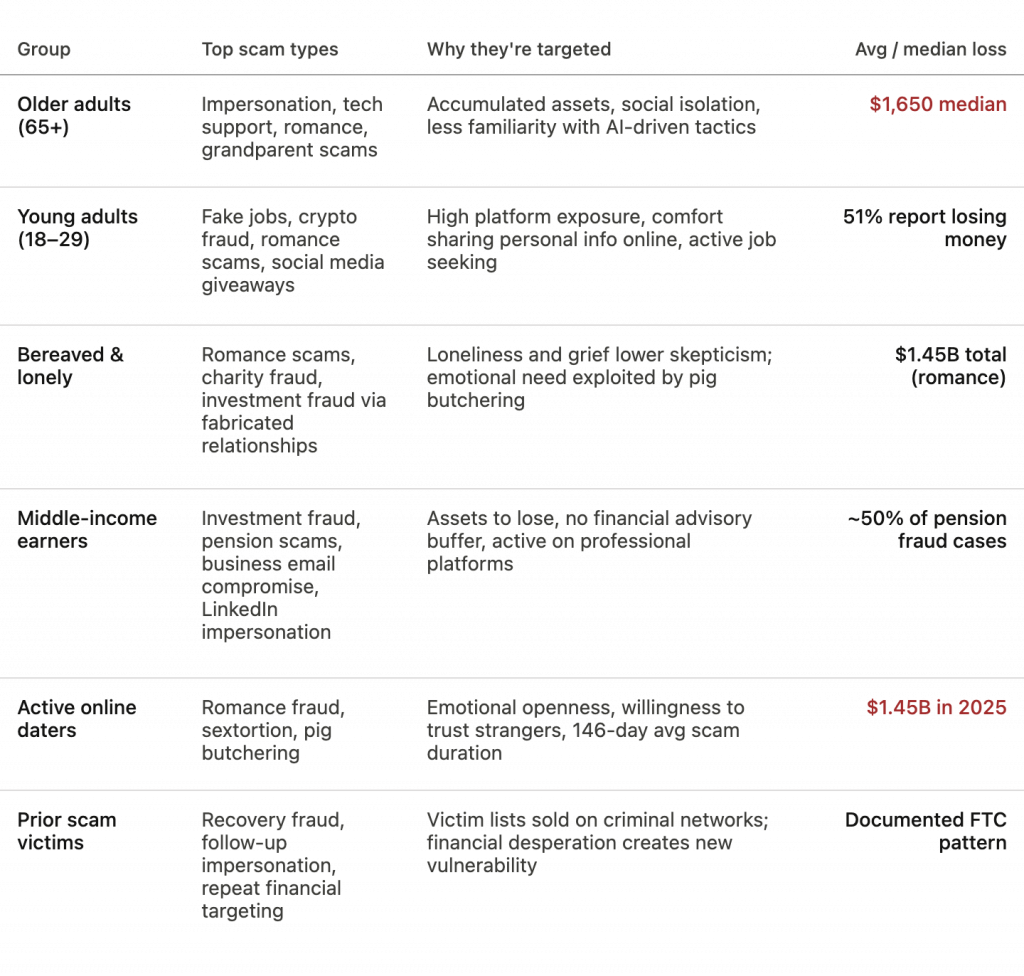
Group 1: Older Adults (65+)
What the data shows: Adults 65 and older are the most financially devastated group when scammed. The FTC documented an eight-fold increase in losses above $100,000 from older adults between 2020 and 2024. Vishing attacks voice phishing by phone, increased 40% against seniors in the last two years alone.
Why they’re targeted:
Scammers target older adults for several well-documented reasons. First, they tend to have more accumulated assets, such as retirement savings, home equity, and pension income, making the potential payoff higher. Second, research consistently links social isolation and loneliness to increased vulnerability: a study in Frontiers in Psychology found that loneliness scores among adults aged 60 to 70 correlate significantly with telemarketing fraud victimization, with one analysis showing a correlation coefficient of 0.92 between increased loneliness and susceptibility to fraud.
Third, some older adults have less familiarity with the specific tactics scammers use online, such as AI-generated voices, spoofed caller IDs, and fake verification messages, making deception easier to sustain.
Most common scams: Impersonation scams (IRS, Social Security Administration, Medicare), tech support scams, romance scams, grandparent scams (a caller claims a grandchild is in trouble and needs immediate money), and lottery or prize fraud.
Group 2: Young Adults (18–29)
What the data shows: Young adults are scammed more frequently than any other age group. F-Secure’s 2025 report found 18 to 24-year-olds are 1.6x more likely to experience cybercrime than adults 55 to 74. The FTC found the youngest consumers had the highest rate of reported financial loss, 51% of fraud complaints from those 19 and under disclosed losing money.
Why they’re targeted:
Young adults spend more time online, across more platforms, with more exposure to strangers. Their comfort with digital interaction, sharing personal details, clicking links, and engaging with unknown accounts is a feature of the online environment they grew up in, but it also creates exposure. They’re active users of dating apps, social media, gaming platforms, and gig economy job boards, all of which are heavily exploited by scammers.
45% of reported crypto and investment fraud victims are in the 18 to 30 range, according to cybersecurity research. Young adults with an active job-seeking status are disproportionately targeted by employment scams. The FTC documented job scam losses growing from $90 million in 2020 to over $501 million in 2024, with adults aged 20 to 29 reporting the highest number of incidents.
Most common scams: Fake job offers, cryptocurrency and investment fraud, romance scams, social media giveaway scams, and phishing via DM on platforms like Instagram, Telegram, and Discord.
Group 3: The Recently Bereaved and the Lonely
What the data shows: This is less a demographic and more a psychological state, but it’s one of the strongest predictors of scam vulnerability in the research. Studies consistently link loneliness, grief, and recent significant loss (of a partner, job, or major life structure) to elevated susceptibility to online fraud.
Why they’re targeted:
Romance scam research published in peer-reviewed psychology journals identifies loneliness and a tendency toward romantic idealization as the strongest individual-level predictors of victimization, stronger than age, income, or education. One study found that high neuroticism combined with loneliness significantly elevated both the likelihood of being victimized and the level of emotional distress afterward.
Scammers specifically seek out signals of vulnerability: recently widowed individuals on social media, people publicly processing grief or major life transitions, and those who engage heavily with strangers online in ways that suggest unmet social needs. A decline in health or loss of intimacy, both common triggers for increased loneliness in older adults, has been directly correlated with fraud susceptibility in multiple studies.
Most common scams: Romance scams, fake investment opportunities introduced through a fabricated relationship, and charity fraud leveraging emotional appeals.
Group 4: Middle-Income Earners (Not the Poorest or Wealthiest)
What the data shows: Contrary to what many expect, the very poorest and very wealthiest individuals aren’t the most scammed. Pew Research’s 2025 data found that Americans across income levels are roughly equally likely to have experienced at least one online scam, but those in lower-income households are more likely to report multiple forms of fraud. The most financially devastating scams disproportionately hit middle-income earners who have assets to lose but lack the financial advisory infrastructure that often protects high-net-worth individuals.
Why they’re targeted:
Middle-income individuals, particularly professionals aged 35 to 54 with some disposable income, are heavily targeted for investment fraud, pension scams, and phishing. Research from The Cyber Helpline identifies this group as accounting for nearly 50% of reported pension fraud cases, specifically targeting those aged 40 to 55. They’re often reached through phishing emails and fraudulent investment websites that look professionally constructed.
This group is also more likely to be active on LinkedIn, where catfishing attempts increased 37% between 2020 and 2023 as scammers shifted toward professional deception and fake business opportunities.
Most common scams: Investment and pension fraud, business email compromise, fake partnership or acquisition offers, and LinkedIn-based impersonation.
Group 5: Active Online Daters
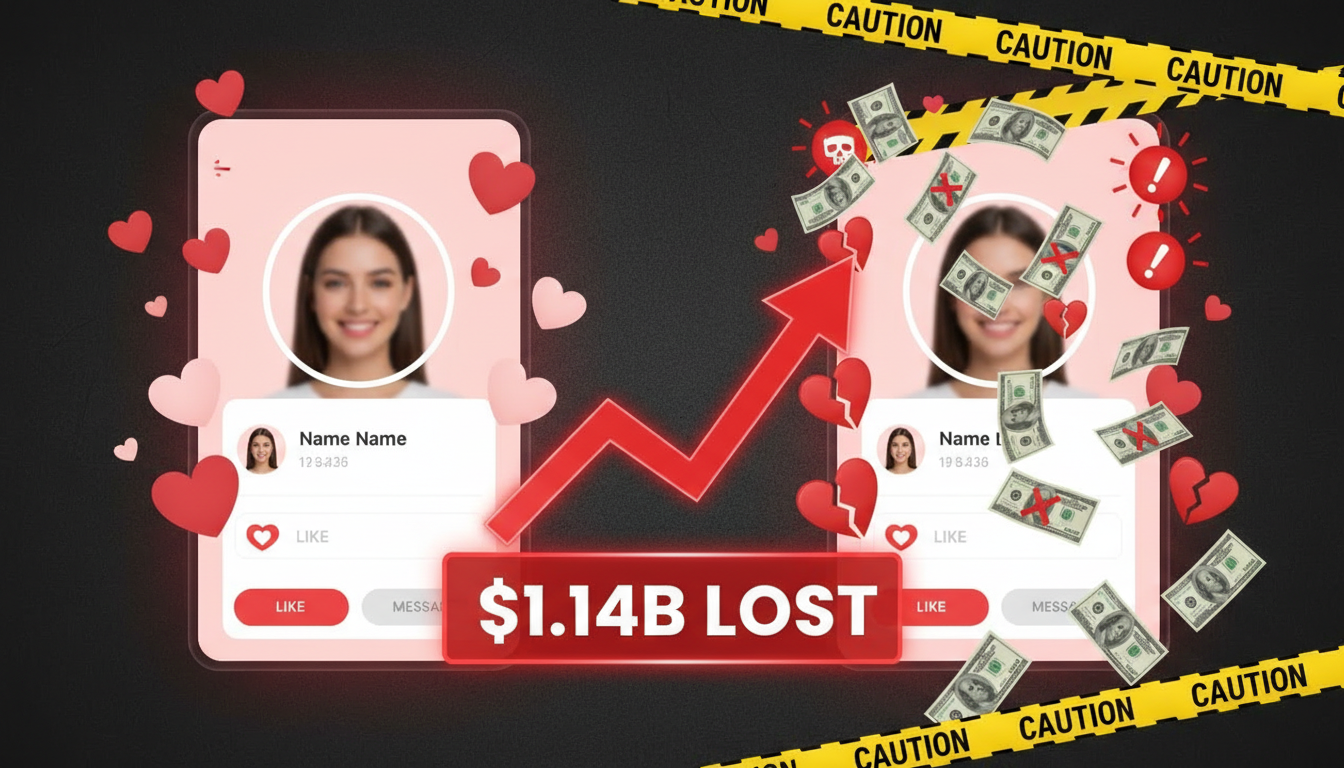
What the data shows: Romance scams cost victims $1.45 billion in 2025, according to FTC data, making it one of the single most financially damaging fraud categories. 55% of online daters say they’ve encountered a profile they believed was fake. The average romance scam lasts 146 days before the victim discovers the deception.
Why they’re targeted:
People actively seeking connection are operating in an emotional state that scammers deliberately exploit. The willingness to engage with strangers, share personal information, and extend trust quickly is inherent to the online dating context, and scammers depend on it. Romance scam research consistently finds that victims are not naive or unintelligent; they’re people whose genuine desire for connection was systematically weaponized.
The scam is engineered to build an emotional attachment strong enough to override skepticism. By the time financial requests appear, the relationship feels real because months of interaction have made it feel real. 70% of victims in some studies continued communicating with scammers even after suspecting fraud, due to emotional attachment.
Most common scams: Romance fraud leading to financial requests, sextortion after intimate content is exchanged, and investment scams introduced through a fabricated relationship (pig butchering).
Group 6: People Who’ve Been Scammed Before
What the data shows: Fraud victims are specifically retargeted. This is a documented pattern in which scammers sell or share victim lists, and a separate category of scam (“recovery fraud”) specifically targets people who have already lost money, posing as lawyers or recovery experts who can retrieve their funds.
Why they’re targeted:
Having been scammed once is not a reliable protector against future scams. If anything, the emotional state following victimization, shame, financial anxiety, and desperation to recover losses creates new vulnerabilities. Recovery fraud exploits all three of these in sequence. The FTC has documented this pattern extensively.
Most common scams: Recovery fraud, follow-up impersonation scams from the same operation, and new fraud approaches targeting the same financial desperation that the first scam created.
What the Data Gets Wrong: The Overconfidence Problem
One of the most consistent findings across scam research is the gap between perceived and actual vulnerability. In Pew’s 2025 survey, 71% of Americans said they know at least a fair amount about how to detect online scams. F-Secure’s research found the opposite dynamic in practice: the more confident consumers feel about their ability to spot scams, the more vulnerable they often become because overconfidence reduces the verification behavior that actually prevents fraud.
Education alone doesn’t close this gap. Knowing that scams exist and knowing how to identify a specific fake identity in real time are different skills. The former creates confidence; the latter requires active verification.
The One Step That Cuts Across Every Group
The statistics describe who gets targeted and why. The practical question is what to do about it.
Across every demographic and vulnerability profile, the single most effective preventive step is verifying who you’re actually talking to before extending trust. Whether the contact came through a dating app, a job board, a social media message, or a phone call, knowing that the identity is real is the check that stops the scam before it starts.
Social Catfish lets you search by name, photo, phone number, email, or username to confirm whether someone is who they claim to be. It cross-references the information against public records, social profiles, and reverse image results, the verification step that most victims later wish they’d taken first.
FAQ
Not exactly. Older adults lose significantly more money per incident. The median loss for those 80+ is nearly nine times higher than for those under 19. But younger adults are scammed more frequently. Both groups are at serious risk for different reasons and through different tactics.
Less than most people assume. Pew Research found Americans across income and education levels are roughly equally likely to experience online scams. Scam vulnerability is more strongly predicted by psychological factors, loneliness, overconfidence, and emotional state than by socioeconomic status.
Victim lists are sold and shared on criminal networks. A documented category of “recovery fraud” specifically targets prior victims, posing as lawyers or recovery services to extract additional money from people who are financially desperate and emotionally vulnerable from the first scam.
It depends on the scam type. Men are more frequently reported as victims of internet fraud overall. Women are more likely to be targeted in romance scams and experience greater emotional distress when victimized. Older women who are victimized tend to lose more money than older men in equivalent scams.
Verify before you trust. The research consistently shows that the victims of scams are not less intelligent than those who avoid them; they simply didn’t verify the identity of those they were dealing with. Running a reverse image search, checking a phone number, or searching a name or username through Social Catfish takes minutes and closes the gap that scammers depend on.
The Bottom Line
The data on who gets scammed online doesn’t point to one group; it points to specific combinations of circumstances, emotional states, and behavioral patterns that scammers have learned to identify and exploit. Older adults face the highest financial losses. Young adults are victimized most frequently. The lonely, the recently bereaved, and the romantically hopeful are specifically sought out. And the overconfident across every age and income group are consistently more vulnerable than they realize.
What the statistics don’t show is that any of these people deserved what happened to them. Scams work because they’re engineered to work. The best protection is the same for everyone: verify who you’re talking to before you trust them. Social Catfish gives you the tools to do that before it matters.
Name Search Examples
To get more accurate results, enter the full name including at least First name, Middle name and Last name.
Email Search Examples
Phone Search Examples
Username Search Examples
Address Search Examples
Start typing the initial part of the address and select from the addresses given dropdown afterward.
We Respect Your Privacy.